Here you will learn about some of the most significant historical and modern masjids in Istanbul
1. Fatih Camii
The Fatih Camii is a deeply historical and significant masjid, originally built between 1463 and 1470 by Sultan Mehmed II the Conqueror (Fatih Sultan Mehmed). It was one of the first major imperial complexes constructed after the conquest of Constantinople. Unfortunately, the original mosque was almost entirely destroyed in a major earthquake in 1766. The current structure was rebuilt between 1767 and 1771 under Sultan Mustafa III by architect Mehmet Tahir Ağa. The present Fatih Camii features an Osmanli Baroque style, a departure from the original classical design. Its interior has a large central dome supported by four semi-domes, creating a spacious and luminous prayer hall. The complex also contains the mausoleum of Fatih Sultan Mehmed II.
The design of the rebuilt Fatih Masjid reflects the new aesthetic tastes of the 18th century. Unlike the symmetrical, pyramid-like compositions of earlier mosques, its design is characterized by a single, massive dome without the cascading domes that define works like the Süleymaniye. The mosque’s courtyard features a portico with a continuous domed roof, and the interior is richly decorated with baroque ornamentation, including fluid, curving lines and elaborate floral motifs. The calligraphy, while not as prominently featured in the main dome as in earlier classical mosques, is still an integral part of the decor, appearing in decorative panels and inscriptions that add to the building’s aesthetic richness.

2. Süleymaniye Camii
Often regarded as the masterpiece of the great Osmanli architect Mimar Sinan, the Süleymaniye Camii (masjid) was commissioned by Sultan Süleyman the Magnificent and built between 1550 and 1557. Its design is a prime example of classical Osmanli architecture. The masjid is distinguished by its four massive minarets, which symbolize that Süleyman was the fourth Osmanli Sultan since the conquest of Istanbul. Its immense dome, supported by four “elephant feet” columns and two semi-domes, creates a vast and unified interior space. The masjid’s design is renowned for its perfect proportions, exceptional acoustics, and the harmonious use of light and color through intricate stained-glass windows and Iznik tiles.
The architectural brilliance of the Süleymaniye lies in its synthesis of engineering and artistry. Mimar Sinan’s design created a soaring, unobstructed prayer hall by ingeniously transferring the weight of the massive central dome to the buttresses and side domes. The interior is a feast for the eyes, with its calligraphy by Hasan Çelebi considered among the finest examples of Osmanli art, adorning the main dome and walls with Quranic verses. The lower walls are decorated with magnificent Iznik tiles in a brilliant blue and red palette, depicting a variety of motifs, while the natural light that floods the space comes from over 130 windows, including stained-glass windows designed by master craftsman Serafettin. The overall effect is to make this masjid one of the grandest and yet most spiritually tranquil masjids in Istanbul.

3. Eyüp Sultan Camii
The Eyüp Sultan Camii is one of Istanbul’s most sacred sites, as it was built at the tomb of Abu Ayyub al-Ansari ؓ, the standard-bearer of the Prophet Muhammad ﷺ who died during a Muslim siege of Constantinople in the 7th century. The original masjid was built by Sultan Mehmed II shortly after the conquest of the city in 1453. However, similar to the Fatih Camii, the original structure was torn down and completely rebuilt between 1798 and 1800 under Sultan Selim III due to extensive earthquake damage. The current masjid’s design is a notable example of the later, more ornate Osmanli baroque and rococo styles. Its courtyard and porticoes are famous for their beautiful tilework and the sacred atmosphere surrounding the adjoining tomb, which draws countless pilgrims to the site.
The current structure of the Eyüp Sultan Camii stands in stark contrast to the grand, classical designs of the Süleymaniye. It is characterized by its single, large dome and a more delicate, curvilinear aesthetic typical of the late Osmanli period. The intricate ornamentation, rococo curves, and ornate detailing on the capitals and arches mark a significant departure from earlier, more severe designs. The masjid’s famous tomb (türbe) of Abu Ayyub al-Ansari ؓ, located in a separate courtyard, is a highlight of the complex and is also richly decorated with fine tilework and inscriptions. The calm, spiritual atmosphere at this masjid and its surrounding market area is a contrast to the touristy rush and crowds found in Sultan Ahmet. This is a visit that you cannot afford to leave out.

4. The Grand Çamlıca Camii
The Grand Çamlıca Masjid, is a monumental and highly symbolic addition to Istanbul’s skyline, located on the highest point of Çamlıca Hill on the city’s Asian side. Inaugurated in 2019, the mosque was designed by two female architects, Bahar Mızrak and Hayriye Gül Totu. Its construction reflects a synthesised approach to religious architecture, blending traditional Osmanli and Seljuk styles with contemporary elements. The huge masjid complex is not just a place of worship; it’s a vast cultural hub, housing a museum of Islamic art, a library, an art gallery, a conference hall, and a large underground parking facility. The project’s massive scale and strategic location make it a symbol of modern Turkiye, visible from across the city and serving as a new landmark.
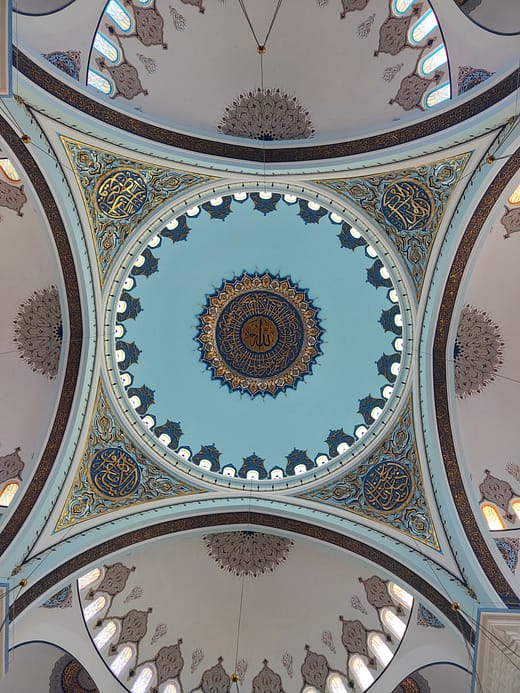
The design of the Çamlıca Masjid is rich with symbolic numbers and features. It stands out with its six minarets. Four of these minarets are a towering 107.1 meters tall, which some say is a symbolic tribute to the Battle of Malazgirt (Manzikert) in 1071, which resulted in a decisive victory of the Seljuks over the Byzantine empire and opened Anatolia to Turkish settlement. The masjid’s main dome is 72 meters high and the secondary dome has a diameter of 34 meters. The interior of the masjid is equally grand, with a capacity to hold up to 63,000 worshippers. Its design incorporates intricate calligraphy, Iznik tiles, and stained-glass windows, creating a spacious and luminous atmosphere for prayer and contemplation. In the architecture, art and colours of this fabulous masjid you will see an amalgamation of all the historic masjids built on the European side of Istanbul by the great Osmanli Sultans.