
1. Sultan Ahmet Camii
The Sultan Ahmet Camii, also known as the Blue Mosque, stands as one of the most iconic monuments of Osmanli architecture and a testament to the ambitions of Sultan Ahmet I, who commissioned its construction during his short reign from 1603 to 1617. Despite ascending the throne at a young age and ruling for only 14 years, Sultan Ahmet sought to leave a lasting legacy by building a grand masjid that would rival the nearby Hagia Sophia. Completed in 1616, the masjid was designed by the architect Sedefkâr Mehmed Ağa, a pupil of the great Mimar Sinan, and is renowned for its harmonious proportions, six slender and tall minarets, and a vast central dome flanked by semi-domes in a cascading arrangement resting upon four truly enormous pillars.
Spanning a massive complex that originally included a madrasa, hospital, and market, the masjid’s scale and layout reflect the Osmanli vision of unifying religious, educational, and civic life. Its vast interior is adorned with more than 20,000 handmade İznik tiles, primarily in shades of blue hence its nickname of The Blue Mosque. Over the centuries, the building has endured multiple earthquakes, notably in 1648, 1766, and 1894, each causing varying degrees of structural damage, especially to the minarets and domes. However, it has consistently been restored and preserved due to its cultural and religious significance.
In recent years, the masjid underwent an extensive renovation project beginning in 2018, which addressed structural wear, restored intricate tilework, and upgraded visitor infrastructure. The restoration, completed in early 2023, aimed to preserve the masjid’s historical integrity while ensuring its continued use as both a place of worship and a major cultural attraction. Today, the Sultan Ahmet Camii remains a breathtaking symbol of Osmanli ambition and artistry, standing resilient through political change, natural disasters, and the passage of centuries.

2. Topkapi Palace
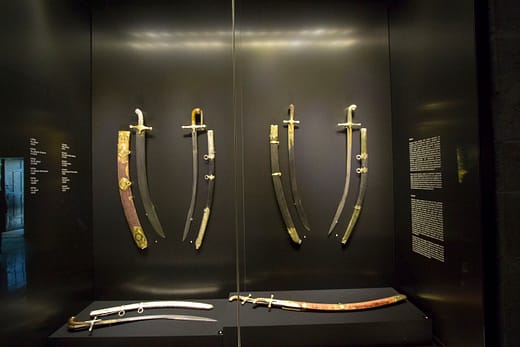
The Topkapi Palace is an essential destination for anyone interested in the grandeur and complexity of Ottoman history. Constructed shortly after the Ottoman conquest of Constantinople in 1453 by Sultan Mehmed II, the palace served as the imperial residence and administrative center of the empire for nearly four centuries. Set atop the ancient acropolis of Byzantium, overlooking the Bosphorus and Golden Horn, its location alone is historically symbolic. What makes Topkapi truly captivating is its layered structure—rather than a single monumental building, it is a sprawling complex of pavilions, courtyards, and gardens that evolved over time to reflect the changing needs and tastes of successive sultans. Visitors can explore the Weapons rooms, the Harem, and the Treasury, which houses artifacts such as the Topkapi Dagger and the Spoonmaker’s Diamond, alongside relics believed to belong to the Prophet Muhammad ﷺ. Beyond its opulence, the palace offers a deep insight into Osmanli governance, daily life, and ceremonial tradition. Careful restorations and ongoing conservation efforts have preserved its architecture and rich interiors, making it not just a historical site but a living museum of imperial power, cultural synthesis, and artistic achievement.
3. The Basilica Cistern
The Basilica Cistern or Yerebatan Sarayi (underground palace) is one of Istanbul’s most atmospheric and historically intriguing landmarks, offering a glimpse into the engineering feats of the Byzantine Empire. Built during the reign of Emperor Justinian I in the 6th century (around 532 CE), the cistern was designed to store and supply water to the Great Palace of Constantinople and surrounding buildings. It earned its name because it was constructed where a former basilica had once stood. Measuring approximately 140 meters long and 70 meters wide, the subterranean chamber could hold up to 80,000 cubic meters of water and is supported by 336 marble columns, many of them repurposed from earlier Roman structures. The cistern’s vaulted ceilings and rows of dimly lit columns create an eerie, cathedral-like ambiance, heightened by the sound of dripping water and the shimmering reflections on its surface.
One of the most famous features of the cistern is the presence of two Medusa-head column bases, one placed sideways and one upside down, which represent the rejction of Roman mythology by the Christian emperor Justinian. Over time, the cistern continued to supply water to the Topkapi Palace and later became disused. After restoration and reopening to the public in the 1980s, the water it holds was reduced to allow visits by the public and it became one of Istanbul’s most popular underground sites. More recently, the Basilica Cistern underwent a significant renovation between 2017 and 2022, reinforcing its structural integrity and upgrading lighting and walkways to enhance both safety and atmosphere. Today, it stands not only as a marvel of Byzantine engineering but also as a hauntingly beautiful reminder of the city’s layered past beneath its modern surface.

4. The Grand Bazaar
The Grand Bazaar (Kapalıçarşı) in Istanbul is one of the oldest and largest covered markets in the world, and a must-visit for anyone fascinated by history, trade, and urban life. Its origins date back to 1455, shortly after the Osmanli opening of Constantinople, when Sultan Mehmed II ordered the construction of a bedesten (a covered market hall) to stimulate the city’s economy and establish it as a commercial hub. Over the centuries, the bazaar expanded organically into a sprawling labyrinth of more than 60 streets and 4,000 shops, becoming the heart of Osmanli commerce and craftsmanship. At its height, it was not just a marketplace but a city within a city, with masjids, fountains, caravanserays, and even police stations and schools embedded within its walls.
The architecture of the Grand Bazaar reflects its historical evolution, with vaulted ceilings, arched passages, and ornate gates—such as the Nuruosmaniye Gate—that reveal a blend of Byzantine, Osmanli, and Islamic influences. Despite suffering damage from fires and earthquakes over the centuries, including major events in 1894 and 1954, the bazaar has been repeatedly restored and remains remarkably intact. Recent renovations have focused on improving infrastructure while preserving its historic character.
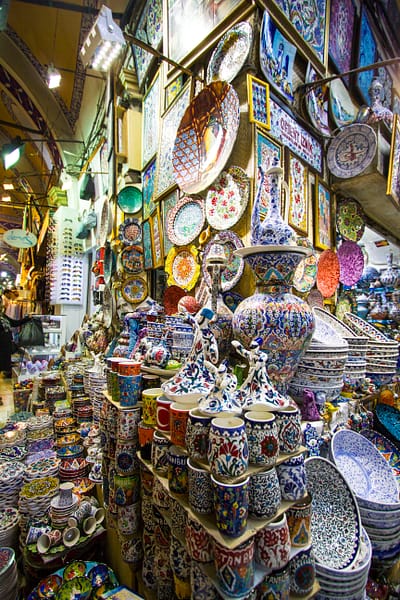
Today, the Grand Bazaar is a vibrant and immersive experience, offering everything from handwoven carpets and antique jewelry to spices, ceramics, and leather goods. It’s a walk through centuries of commerce, culture, and cosmopolitan life in the heart of Istanbul and haggling with the hospitable and friendly traders is an experience not to be missed.
5. Hagia Sophia Masjid
The Hagia Sophia Masjid stands as one of the most enduring symbols of architectural and religious history in the world, remarkable for both its age and the preservation of many original features. First completed in 537 CE under the Byzantine Emperor Justinian I, it served as the principal church of Constantinople and the seat of the Eastern Orthodox Patriarchate for nearly a thousand years. Designed by the architects Anthemius of Tralles and Isidore of Miletus, the Hagia Sophia was a groundbreaking achievement of its time, particularly for its massive central dome, which spans over 30 meters and seems to float above the nave thanks to a sophisticated system of pendentives and hidden support structures.
After its conversion into a masjid following the Osmanli conquest of 1453, much of the original Byzantine architecture and decoration was preserved. Osmanli rulers added Islamic elements such as minarets, a mihrab, mimbar, and calligraphic features, but they also respected the building’s grandeur and retained features like the marble columns, intricate mosaics, and imperial doorways. Many of these mosaics, including depictions of Jesus, the Virgin Mary, and various emperors, still survive, partially revealed where not covered for Islamic use. These ancient artworks are among the few surviving examples of Byzantine mosaic art in their original setting.
Despite earthquakes and centuries of use, the Hagia Sophia’s structure has held remarkably well due to both its ingenious design and continuous restoration efforts, most notably by Ottoman architect Mimar Sinan in the 16th century. Today, after serving as a museum throughout most of the 20th century, the Hagia Sophia is used once again as a masjid since 2020, though it remains open to all visitors. Stepping into its vast interior, one experiences a unique and powerful fusion of Christian and Islamic heritage, preserved within a nearly 1,500-year-old structure that continues to serve as a living monument to the layers of Istanbul’s rich past.
